Mouse trap vs poison
Both kill mice. Only one of them lets you control where the mouse dies, and only one of them stops there.
By Ryder M.Published Updated
Swat & Snap earns a commission from qualifying purchases made through the links on this page, at no extra cost to you. It does not change which products we pick — see how we pick and our affiliate disclosure.
What poison actually does
Most consumer rodent bait is an anticoagulant. It blocks vitamin K recycling, which stops blood clotting, and the animal dies of internal bleeding over a period of days. Second-generation anticoagulants — brodifacoum, bromadiolone, difethialone, difenacoum — are potent enough to be lethal from a single feed, and they persist in the liver of the animal that ate them.
That persistence is the whole problem, and it is the reason the EPA has spent years tightening the rules on how these products may be sold to consumers, including requiring tamper-resistant bait stations for residential use.
Two consequences follow, and neither is on the front of the box.
Consequence one: you do not choose where it dies
A mouse that eats bait does not die at the bait station. It goes back to the nest, which is inside a wall cavity, under a floor, or above a ceiling, and it dies there over the following days.
What you get is a smell. It builds over a week, peaks for two or three, and fades over a month or more depending on temperature. There is no way to reach it without opening the structure, and there is no product that neutralizes it — the odor-eliminating sprays sold alongside rodenticide mask the air, not the source.
A trap, by contrast, puts the dead mouse exactly where you put the trap. That is not a small advantage. It is the main one.
Consequence two: the poison keeps working after the mouse
A poisoned mouse is slow, disoriented and easy to catch for a day or two before it dies. That makes it unusually likely to be eaten — by a cat, a dog, an owl, a hawk, or a fox.
Whatever eats it takes on the anticoagulant. This is called secondary poisoning, it is well documented in raptors and in domestic pets, and second-generation anticoagulants are the worst offenders precisely because they persist. If you have a cat that hunts, or neighbors who do, or owls in the area, this is the risk you are taking on and it is not theoretical.
Our pet-safe rat poison page goes through this in more detail, including the products marketed as lower-risk and what they actually change.
Quick picks
| # | Product | Best for | Mechanism | Price |
|---|---|---|---|---|
| 1 | 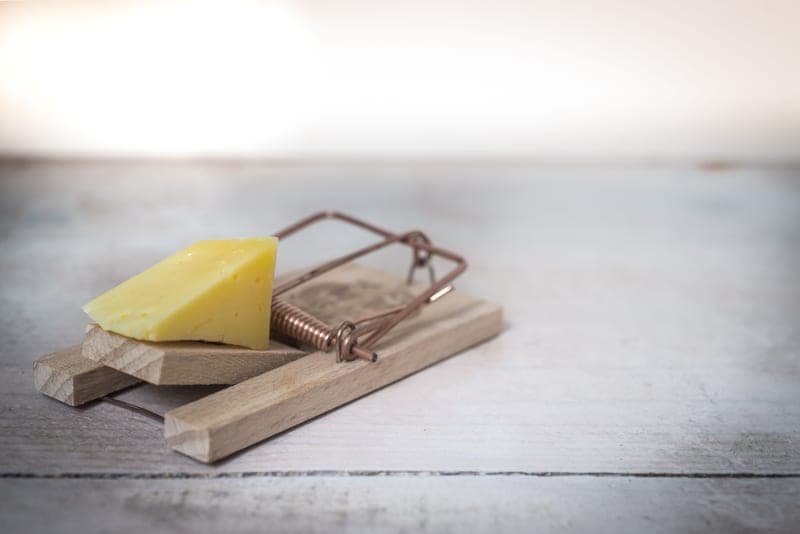 Our pickVictor Metal Pedal Mouse Trap (M150)The wooden snap trap everything else is measured against. Cheap enough to set a dozen, which is how mouse trapping actually works. | Most homes, in quantity | Spring-loaded bar, metal pedal | |
| 2 |  Victor Electronic Mouse Trap (M250S)A battery tunnel that delivers a high-voltage shock. You tip the mouse out without seeing or touching it, which is the whole appeal. | No-touch disposal indoors | High-voltage shock inside a tunnel | |
| 3 |  Tomcat Child & Dog Resistant Refillable Mouse StationA locking station for people who have decided on bait. The station is the safety feature; the bait inside it still carries a secondary-poisoning risk. | Bait that must stay out of reach | Locked tamper-resistant station |
#ad — every price link goes to Amazon and Swat & Snap earns a commission on qualifying purchases. No price is shown until it can be pulled live from the retailer.
Victor Metal Pedal Mouse Trap (M150)
Victor · Most homes, in quantity
The wooden snap trap everything else is measured against. Cheap enough to set a dozen, which is how mouse trapping actually works.
- Costs little enough that quantity stops being a decision
- The metal pedal fires on weight, so a mouse cannot lick the bait off
- Nothing to charge, nothing to refill
- You see the result, and you have to handle it
- Exposed bar is a genuine hazard to a dog's nose or a toddler's fingers
Check price on Amazon
Victor Electronic Mouse Trap (M250S)
Victor · No-touch disposal indoors
A battery tunnel that delivers a high-voltage shock. You tip the mouse out without seeing or touching it, which is the whole appeal.
- The tunnel is the safety feature — a dog's nose does not fit the plates
- Indicator light means you are not checking traps blind
- Tip-out disposal, no handling
- Batteries die, usually unnoticed, and a dead trap catches nothing
- Has to sit flat against a wall run or mice walk past it
Check price on Amazon
Tomcat Child & Dog Resistant Refillable Mouse Station
Tomcat · Bait that must stay out of reach
A locking station for people who have decided on bait. The station is the safety feature; the bait inside it still carries a secondary-poisoning risk.
- A dog cannot open it, which is the entire point of a station
- Refillable, so one station covers a long campaign
- Does nothing about secondary poisoning of a cat, an owl or a fox
- Mice die inside walls — a smell you cannot reach
Check price on Amazon
The comparison
| Traps | Anticoagulant bait | |
|---|---|---|
| Where the mouse dies | Where you set the trap | Wherever it happens to be, usually a wall |
| Smell | None | Likely, for weeks |
| Confirms the problem is over | Yes — you count catches | No — bait disappearing tells you nothing about numbers |
| Risk to a cat or dog that eats the rodent | None | Real, and worse with second-generation actives |
| Risk to owls, hawks, foxes | None | Documented |
| Works while you are away | For one catch each | Continuously |
| Scales to a large infestation | Needs many traps | Yes |
| Child-safety requirement | Keep out of reach | Tamper-resistant station, legally required in many cases |
The middle ground, if you are set on bait
If the infestation is large, or the access is bad enough that trapping genuinely cannot reach it, there is a version of baiting that removes most of the objection.
Buy the tamper-resistant station — and load it with snap traps instead of bait.
A locked station is a genuinely good piece of equipment: weatherproof, anchored, key-opened, and a dog cannot get into it. Everything that makes it a safe place to put poison also makes it a safe place to put two snap traps. You get the placement advantage, the tamper resistance and the protection from weather, with no carcass in the wall and nothing to poison the neighborhood cat.
That is what we would do, and it is why a station appears in the picks above alongside the traps rather than as a poison recommendation.
If you use bait anyway: only in a locked station, only following the label exactly — the label is legally binding and overrides anything written here — never loose pellets, and never where a pet or a child can reach the station.
When bait is genuinely the better call
We are not absolutists. There are cases where trapping does not work:
- A large, established infestation across a structure where you cannot access the runs at all.
- A commercial or agricultural building where trap-checking at the necessary frequency is not realistic.
- A situation a licensed professional has assessed and specified bait for, with a placement plan and a carcass-recovery plan.
The last one is the key difference. A professional using rodenticide is managing the consequences deliberately. A homeowner buying a tub of pellets usually is not, because nothing on the packaging told them there would be consequences to manage.
If the problem is genuinely that large, how to get rid of mice covers when to stop and call someone, and that is the honest answer more often than an upgrade to stronger poison.
Frequently asked
Will a poisoned mouse die in my walls?
Is rat and mouse poison dangerous to pets?
Is there a poison that does not cause secondary poisoning?
How long does mouse poison take to work?
More on mice
One mouse is rarely one mouse. This hub covers what kills them, what only looks like it does, and where to put the thing you buy.
Not sure yet? Read how we pick.
Ryder M.
Ryder M. is the hands-on owner behind Magoo Media Group. He writes Swat & Snap because he got tired of pest-control advice that was either a sales pitch or a scare story.
Related on Swat & Snap
- The best mouse traps, by situationSix traps chosen by situation — cheap and plentiful, pet-safe by design, no-touch, or live catch.
- Is there pet-safe rat poison?The honest answer is no — here is what the lower-risk products actually change, and what to do instead.

- Rat trap vs poisonWhere the rat dies, what happens next, and why a locked station full of traps beats a locked station full of bait.
- The best rat bait stationsTamper-resistant stations that actually lock — and the case for loading them with traps rather than bait.

- How to get rid of miceThe full sequence: find the runs, trap in quantity, bait small, seal the gaps. Timeline and what to skip.