Rats in the walls
A rat in a wall cavity is using the void as a highway, not a home — which is good news, because it means you can trap it without taking the wall apart.
By Ryder M.Published Updated
Swat & Snap earns a commission from qualifying purchases made through the links on this page, at no extra cost to you. It does not change which products we pick — see how we pick and our affiliate disclosure.
Confirm it is rats first
What you do next depends on the species, so spend five minutes on this before buying anything.
Sound. Rats in a cavity are audible as heavy scrabbling, thumps and dragging, and you often hear gnawing you can feel through the plasterboard. It comes in bursts, mostly in the first hours after dark and again before dawn. Mice in the same void sound lighter and faster — scratching rather than thumping. A steady rhythmic scratching in daylight, especially high in a wall, can also be birds or squirrels.
Droppings. This is the reliable test. Rat droppings are two to three times the length of a mouse's, blunt at the ends, often slightly curved, and they turn up in concentrated piles rather than scattered everywhere. Look along the baseboard, under the sink, behind the washing machine, in the back of a low cupboard and at the base of the wall outside.
Gap size. A rat needs an opening about the diameter of a golf ball; a mouse needs the width of a pencil. If the holes you find are small and neat, you are dealing with mice — mice in walls is the page you want.
Smears. Rats leave dark greasy rub marks around the hole they use and along the route they take. The marks are at rat height — a few inches up a wall — and they do not wipe off easily.
Mice vs rats has the full comparison, and it changes everything downstream: trap size, pre-baiting, and the size of the gap you need to close. A mouse trap on a rat run will injure rather than kill, which is both cruel and the fastest way to make the rest of the population trap-shy.
Why the wall is a corridor, not a target
Rats nest where it is dark, dry and undisturbed and travel to where the food is. In a house, a wall cavity, a suspended floor void and a ceiling space are the connecting routes between those two places. Norway rats typically nest low — in a burrow outside, under a deck, in a crawl space, beneath a shed — and travel up into the walls. Roof rats do the reverse and come down from above.
That has one important consequence: the rats are leaving the wall every night. You do not need to reach them inside the cavity. You need to find where they come out and meet them there.
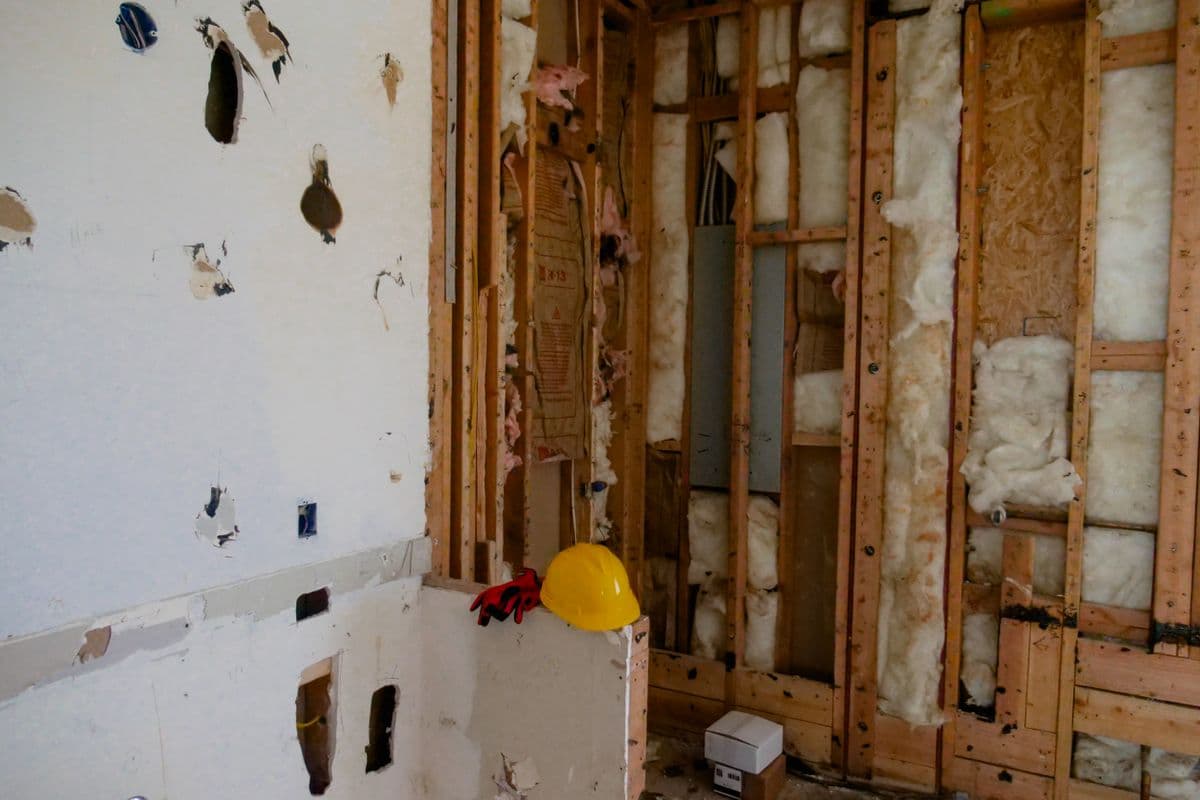
This is why "open the wall" is almost always the wrong first move. It costs money, it makes a mess, it releases dust you then have to clean up properly, and it is unnecessary in the large majority of cases. There are two exceptions, both covered below.
Find the exits
Work from the sound to the openings. Take a flashlight and look at low level, inside and out.
Inside:
- Under and behind the kitchen units, particularly where the waste pipe and water supply pass through the wall
- Behind the washing machine, dishwasher and water heater
- Where heating pipes or cables pass through a wall or floor
- At the back of airing cupboards and understairs cupboards
- Loose or lifted kickboards — pull one off and look
- Floor-to-wall junctions in older properties with suspended floors
Outside, at the base of the same wall:
- Burrow holes about the diameter of a golf ball against the foundation, often hidden under a shrub, a step or a slab
- Gaps where the siding meets grade, and weep holes
- Service penetrations for gas, water, waste, electricity and air conditioning lines
- Crawl-space vents and access hatches with damaged mesh
- The gap under a garage door or a worn door sweep
Marking fresh droppings and smears at each candidate hole tells you which ones are live. Those are your trap positions.
What to look for in a trap here
Full rat size, not a mouse trap. A snap trap built for rats, or an electronic rat trap, has the force to kill cleanly. Anything smaller injures.
Enclosure or a protected position. Traps at a wall base are often in reach of a pet or a child, so either place them inside a locked station, or inside the cupboard and behind the appliance where nothing else can get to them. Best rat traps covers the main options and pet-safe rat traps judges them against that constraint specifically.
An electronic trap for an enclosed void. In a crawl space or behind an appliance, a battery electronic trap that kills on contact, holds the carcass inside and shows a light when it has fired saves you crawling in to check. Best electronic rat traps ranks them.
Quantity. Buy more traps than you think you need — four to six at the exits of a single active wall is realistic, and traps in multiples are how you catch most of a population in one night rather than educating it over a fortnight.
No poison inside a building. A rat that takes bait dies where it happens to be, which here means inside the cavity you cannot reach. The smell lasts weeks, and the secondary risk to pets and wildlife is real. Rat trap vs poison makes the full argument.
Quick picks
| # | Product | Best for | Mechanism | Price |
|---|---|---|---|---|
| 1 |  Our pickVictor Easy Set Rat Trap (M205)The rat-sized version of the trap that defined the category. Enough spring force to be lethal instantly, which matters more with rats than with mice. | Most rat jobs | Spring bar, expanded trigger pedal | |
| 2 |  Victor Electronic Rat Trap (M240)A large shock tunnel that handles rat-sized animals. The no-touch disposal is worth more in an attic than anywhere else in the house. | Attics and crawl spaces | High-voltage shock tunnel | |
| 3 |  Kat Sense Large Rat TrapsPlastic jaw traps sold in packs. Individually less forceful than a Victor; collectively they let you cover every runway at once, which is how rat trapping actually succeeds. | Buying traps in quantity | Plastic jaw, serrated bite |
#ad — every price link goes to Amazon and Swat & Snap earns a commission on qualifying purchases. No price is shown until it can be pulled live from the retailer.
Victor Easy Set Rat Trap (M205)
Victor · Most rat jobs
The rat-sized version of the trap that defined the category. Enough spring force to be lethal instantly, which matters more with rats than with mice.
- Kills instantly when placed square to a runway, which cheap traps often do not
- Wide pedal fires even on a cautious approach
- Genuinely dangerous to set in a home with pets — it must be boxed
- Rats are neophobic: expect to leave it unset for several days first
Check price on Amazon
Victor Electronic Rat Trap (M240)
Victor · Attics and crawl spaces
A large shock tunnel that handles rat-sized animals. The no-touch disposal is worth more in an attic than anywhere else in the house.
- Tunnel shape keeps the plates away from paws
- You tip it out — no bar to release over a dead rat
- D cells, and it drains them faster than the box suggests
- Damp crawl spaces corrode the contacts
Check price on Amazon
Kat Sense Large Rat Traps
Kat Sense · Buying traps in quantity
Plastic jaw traps sold in packs. Individually less forceful than a Victor; collectively they let you cover every runway at once, which is how rat trapping actually succeeds.
- Quantity is the strategy with rats, and these make quantity affordable
- Foot-press arming means you never put a hand near the jaw
- Less spring force than a metal-bar trap on a big Norway rat
- Jaws weaken after repeated cycles
Check price on Amazon
Trapping at the exits
Rats are neophobic: they avoid new objects for days. This is the single biggest difference from trapping mice, and skipping it is why most people conclude that rat traps do not work.
- Place the traps, baited but unset, flush against the wall at each live exit, with the trigger end toward the hole.
- Leave them three to five nights. Let the rats feed off them with nothing happening. Top the bait up each day.
- Arm every trap on the same night. Not one at a time — all of them.
- Check daily. Clear catches with gloves, bag them, and reset.
- Keep going for a week after the last catch, then start sealing.
Bait with something greasy and aromatic that cannot be carried off: peanut butter with oats worked in, bacon fat, or a piece of dried fruit tied to the trigger. Best rat trap bait ranks them, and trap-shy rats is the recovery plan if you have already set traps cold and spooked them.
Then seal, in this order
Sealing before the cavity is clear traps a rat inside the wall, which is the one mistake that genuinely does force you to open it. So: trap first, confirm silence, then close up.
- Use metal, not foam or sealant alone. Rats chew straight through expanding foam, caulk and plastic. Use hardware cloth of about quarter-inch mesh, sheet metal, or a mortar patch.
- Close everything over about half an inch, which is smaller than the golf-ball figure for comfort.
- Seal the outside first, then the inside, so you are closing the supply line rather than just the end of the corridor.
- Pay attention to the service penetrations — they are the commonest route and the easiest to patch properly with mesh and mortar.
- Fit a proper screened cover to crawl-space vents, and replace worn door sweeps.
- Deal with the climb, if it is roof rats: trim branches back six feet from the roof, sleeve or guard downpipes, and close gaps at the eaves and roof line. Rats in the attic covers that case in detail.
The two cases where you do open the wall
A carcass you cannot find. If the catches have stopped but there is a strong sweet-rotten smell that gets worse over several days and localises to one spot, something died in the void. It will pass in two to four weeks, but in a living space most people would rather make a small inspection hole at the smell's centre, remove it, disinfect and patch. Keep the hole small and low.
A nest in the cavity itself. If activity continues after a full trapping cycle at every exit you can find, and the sound never moves, there may be a nest in the void with an entry you have not located — commonly from a crawl space below or a soffit above. That is the point to open a small section, or to get a professional with a borescope.
Neither is the starting move.
Cleaning up and staying clear
Wear gloves. Wet droppings, urine stains and nest material with disinfectant and wipe them up — never sweep or vacuum dry, which is the CDC's standing guidance because dry sweeping puts particles into the air. Double-bag the waste and bin it outside. Insulation that has been soiled does not clean and should be replaced.
Then remove the reason they came: trash in lidded bins, pet food up overnight, dry goods in metal or glass, fallen fruit cleared, woodpiles off the ground and away from the wall, and dense ground cover thinned back from the foundation. Rats in the yard covers the habitat work and how to get rid of rats is the whole campaign in order.
Leave two traps set at the old exits for a month. A quiet trap is cheap insurance, and rats under outside pressure will test the same route again.
Frequently asked
How do I get rats out of a wall cavity?
Should I open the wall to get a rat out?
How do I know if it is rats or mice in the wall?
Can I use poison for rats in a wall?
How long does it take to get rats out of a wall?
More on rats
Rats are cautious, strong and much harder to trap than mice. Everything here assumes you only get one good attempt at a wary animal.
Not sure yet? Read how we pick.
Ryder M.
Ryder M. is the hands-on owner behind Magoo Media Group. He writes Swat & Snap because he got tired of pest-control advice that was either a sales pitch or a scare story.
Related on Swat & Snap
- How to get rid of ratsPre-bait, set everything at once, then exclude. Timeline, the harborage audit, and when to call someone.

- The best rat traps, by situationSnap, electronic, self-resetting and live traps compared — plus the pre-baiting step that decides success.
- Rats in the atticRoof rats, joist-run trapping, the branches that let them in, and the honest limits on the clean-up.
- Trap-shy ratsWhy a survivor stops feeding, and the reset that gets a stalled campaign working again.
- The best electronic rat trapsNo-touch disposal where it matters most. Battery life, damp, and how to place them on a joist run.

- Mice in wallsWhy you trap outside the cavity, how to find the exit points, and what to do about the smell.
- Mice vs rats: which one do you actually have?Droppings, sound, gnaw marks and gap size — the fast way to tell mice from rats before you buy a trap.