Mice in walls
You can hear them and you cannot reach them. The answer is not to open the wall — it is to work out where the run comes out.
By Ryder M.Published Updated
Swat & Snap earns a commission from qualifying purchases made through the links on this page, at no extra cost to you. It does not change which products we pick — see how we pick and our affiliate disclosure.
What you are actually hearing
Scratching and scrabbling inside a wall, usually in the evening, usually in the same part of the house each night. It travels vertically as well as horizontally, because a stud cavity is a shaft and mice climb it easily.
That noise is not mice living permanently sealed inside a void. Wall cavities are a route and a nest site, but there is no food in there. Every mouse you can hear is leaving the cavity regularly — to your kitchen, your pantry, or your garage — and coming back.
That is the whole strategy: you do not have to reach into the wall. You have to find where they come out.
Before going further, confirm the animal. If the noise has weight behind it — a thump or a drag rather than a scratch — you are dealing with rats, and rats in the attic is the better page. Mice vs rats settles it.
Finding the exit points
Mice leave a cavity wherever the wall has already been opened for something else. In order of likelihood:
- Under the kitchen sink, around the waste pipe and the supply pipes. Look at the hole the plumber cut, not the pipe.
- Behind the kitchen kickboard. The void under base cabinets connects directly to the cavity in most builds, and most kickboards unclip in seconds.
- Behind and under the refrigerator, where the power and water lines run.
- Around the boiler or water heater, at the pipe and flue penetrations.
- Where cables enter a cupboard — the hole is always bigger than the cable.
- At the top of the wall in the attic, where the cavity opens into the roof space.
Use a flashlight held low and look for droppings concentrated right at a hole, and for grease darkening around its edge. That is an active exit.
Trapping at the exits
Set traps immediately beside the opening, perpendicular to the wall, trigger end toward the hole. Not across the room — within a few centimeters, so the mouse meets the trigger as it emerges.
Use enough of them: two at each active exit, and more along the runway that leads away from it. The general placement rules in where to place mouse traps apply, with the exit itself taking priority over everything else.
Quick picks
| # | Product | Best for | Mechanism | Price |
|---|---|---|---|---|
| 1 | 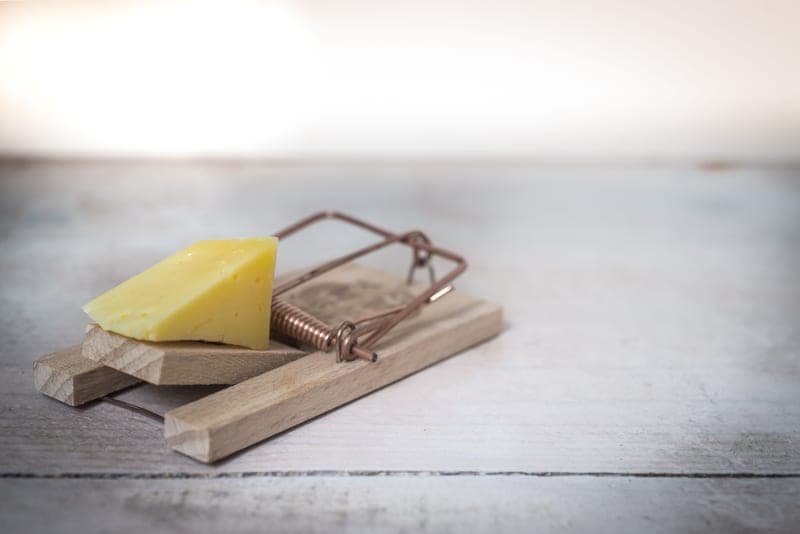 Our pickVictor Metal Pedal Mouse Trap (M150)The wooden snap trap everything else is measured against. Cheap enough to set a dozen, which is how mouse trapping actually works. | Most homes, in quantity | Spring-loaded bar, metal pedal | |
| 2 |  Victor Kill Vault Mouse Trap (M267)A snap trap sealed inside a plastic vault. The kill happens out of sight and out of reach, and you never touch the mouse. | Homes with a dog or a toddler | Enclosed snap bar in a sealed chamber | |
| 3 |  Victor Electronic Mouse Trap (M250S)A battery tunnel that delivers a high-voltage shock. You tip the mouse out without seeing or touching it, which is the whole appeal. | No-touch disposal indoors | High-voltage shock inside a tunnel |
#ad — every price link goes to Amazon and Swat & Snap earns a commission on qualifying purchases. No price is shown until it can be pulled live from the retailer.
Victor Metal Pedal Mouse Trap (M150)
Victor · Most homes, in quantity
The wooden snap trap everything else is measured against. Cheap enough to set a dozen, which is how mouse trapping actually works.
- Costs little enough that quantity stops being a decision
- The metal pedal fires on weight, so a mouse cannot lick the bait off
- Nothing to charge, nothing to refill
- You see the result, and you have to handle it
- Exposed bar is a genuine hazard to a dog's nose or a toddler's fingers
Check price on Amazon
Victor Kill Vault Mouse Trap (M267)
Victor · Homes with a dog or a toddler
A snap trap sealed inside a plastic vault. The kill happens out of sight and out of reach, and you never touch the mouse.
- The enclosure is the reason to buy it: a dog cannot get to the bar
- Seals after firing, so there is no smell and nothing to see
- Sets by pressing the lid, not by arming a bar with your fingers
- Single-use, so a real infestation gets expensive
- Bulkier than a bare snap trap in a tight wall run
Check price on Amazon
Victor Electronic Mouse Trap (M250S)
Victor · No-touch disposal indoors
A battery tunnel that delivers a high-voltage shock. You tip the mouse out without seeing or touching it, which is the whole appeal.
- The tunnel is the safety feature — a dog's nose does not fit the plates
- Indicator light means you are not checking traps blind
- Tip-out disposal, no handling
- Batteries die, usually unnoticed, and a dead trap catches nothing
- Has to sit flat against a wall run or mice walk past it
Check price on Amazon
Then seal, in the right order
Seal after the catching stops, not before. Sealing a cavity with mice still in it traps them inside, where they die and where the smell is unreachable.
Work from the outside in:
- Outside the building, close every gap above about 6 mm: pipe and cable entries, the dryer vent, gaps at the foundation line, damaged crawl space vents, the garage door seal. Coarse steel wool or copper mesh packed in, then sealed over. Mice chew through foam and caulk alone; they do not chew metal.
- Inside, close the openings you trapped at: around pipes under the sink, the gaps behind the kickboard, cable penetrations in cupboards.
- Attic and basement, where the cavity opens at the top and bottom of the wall.
About opening the wall
Almost never worth it.
It is disruptive, expensive to make good, and it usually misses — a stud bay is one of many, and mice move between them. The exception is a genuine structural problem, which is a professional's call rather than a Saturday afternoon's.
The one case where a small, deliberate opening helps is a known dead mouse whose smell you cannot live with, and even then a professional can usually locate it more precisely than you can.
The dead mouse smell
If a mouse dies inside the cavity — which is exactly what happens if you use poison, and the main reason we argue against it in mouse trap vs poison — here is the honest picture.
- The smell builds over about a week, peaks for two to three weeks, and fades over a month or more. Warmer weather makes it stronger and shorter; cold weather makes it fainter and much longer.
- Nothing you can buy removes it, because the source is inside the structure. Odor sprays and charcoal bags treat the air, not the cause. They help; they do not solve it.
- Ventilating the room aggressively — windows open, a fan pushing air out — does more than any product.
- If it is genuinely unbearable and you can localize it to within a few inches, a small cut in the drywall, retrieval, then patching is the only real fix.
This is the part of the poison decision that never appears on the packaging, and it is why we recommend traps indoors as a default.
When it is not mice
- A daytime noise, particularly early morning, in the roof rather than the wall: squirrels. Louder, heavier, and active in daylight.
- A rustling that moves only downward, with no return: sometimes a bird that has come in at the eaves.
- A sound with real weight behind it, plus large droppings: rats. Start here.
Frequently asked
How do I get mice out of my walls without opening them?
Should I put poison in the wall for mice?
How long does a dead mouse in a wall smell?
Why do I hear scratching in the wall at night?
More on mice
One mouse is rarely one mouse. This hub covers what kills them, what only looks like it does, and where to put the thing you buy.
Not sure yet? Read how we pick.
Ryder M.
Ryder M. is the hands-on owner behind Magoo Media Group. He writes Swat & Snap because he got tired of pest-control advice that was either a sales pitch or a scare story.
Related on Swat & Snap
- How to get rid of miceThe full sequence: find the runs, trap in quantity, bait small, seal the gaps. Timeline and what to skip.
- Rats in the atticRoof rats, joist-run trapping, the branches that let them in, and the honest limits on the clean-up.
- Where to place mouse trapsHow to read a runway, how to orient a trap, and the three rooms people forget to cover.
- Mouse trap vs poisonRodenticide works — and then the carcass is in your wall and a cat can be poisoned by eating it. The honest comparison.
- Mice vs rats: which one do you actually have?Droppings, sound, gnaw marks and gap size — the fast way to tell mice from rats before you buy a trap.
