Where to place mouse traps
A cheap trap in the right place beats an expensive trap in the wrong one, and it is not close. Placement is the whole game.
By Ryder M.Published Updated
Swat & Snap earns a commission from qualifying purchases made through the links on this page, at no extra cost to you. It does not change which products we pick — see how we pick and our affiliate disclosure.
How a mouse moves, and why it decides the placement
House mice are prey animals with poor eyesight. They navigate by touch — specifically, by keeping their whiskers and one flank in contact with a vertical surface. They use the same routes every night, and they cross open floor only when they have to.
Everything about trap placement follows from that:
- Traps go against walls. Not near them, against them.
- Perpendicular, not parallel. The trigger end should touch the baseboard so a mouse running the wall meets the trigger square. A trap laid parallel presents its long side and gets stepped over.
- Where the droppings are, not where you saw the mouse. The sighting was a mouse in transit; the droppings mark the route.
- In pairs at the busiest points. Mice occasionally leap the first trap; a second one 10 cm behind it catches those.
Reading a runway in two minutes
Take a flashlight and hold it low, almost flat against the floor, pointing along the baseboard. The angle reveals things overhead light does not.
You are looking for:
- Droppings in a line. A line is a route. A scatter is a visit.
- Grease marks — a faint dark smear along the wall at mouse-shoulder height, from oils in the fur.
- Tracks in dust, particularly behind appliances and in the back of cupboards.
- Gnaw damage at cupboard corners, on packaging, at the bottom of doors.
If none of that is visible, slide a few monitoring glue boards under the refrigerator, the washing machine and the base of the pantry overnight. Whichever picks up hair or droppings has found the route — then lift the board and put real traps there. That is the only use we recommend for glue boards, and the reasoning is in snap trap vs glue trap.
Quick picks
| # | Product | Best for | Mechanism | Price |
|---|---|---|---|---|
| 1 | 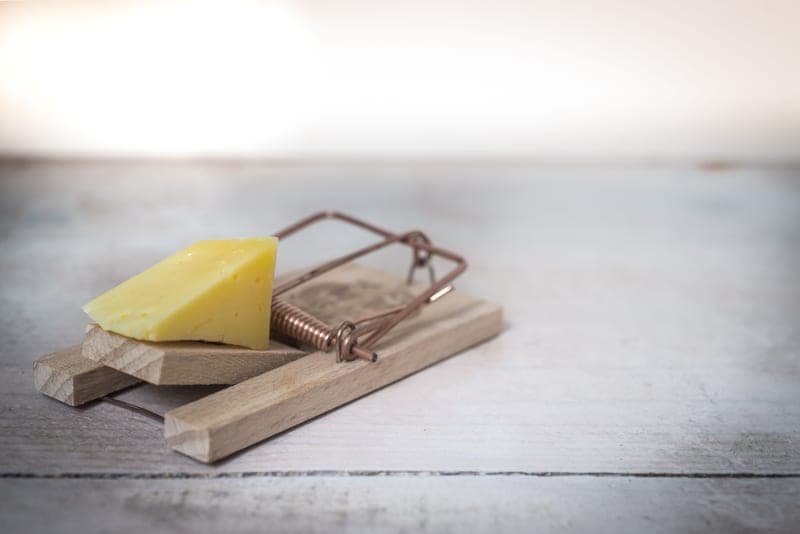 Our pickVictor Metal Pedal Mouse Trap (M150)The wooden snap trap everything else is measured against. Cheap enough to set a dozen, which is how mouse trapping actually works. | Most homes, in quantity | Spring-loaded bar, metal pedal | |
| 2 |  Victor Kill Vault Mouse Trap (M267)A snap trap sealed inside a plastic vault. The kill happens out of sight and out of reach, and you never touch the mouse. | Homes with a dog or a toddler | Enclosed snap bar in a sealed chamber | |
| 3 |  Victor Electronic Mouse Trap (M250S)A battery tunnel that delivers a high-voltage shock. You tip the mouse out without seeing or touching it, which is the whole appeal. | No-touch disposal indoors | High-voltage shock inside a tunnel |
#ad — every price link goes to Amazon and Swat & Snap earns a commission on qualifying purchases. No price is shown until it can be pulled live from the retailer.
Victor Metal Pedal Mouse Trap (M150)
Victor · Most homes, in quantity
The wooden snap trap everything else is measured against. Cheap enough to set a dozen, which is how mouse trapping actually works.
- Costs little enough that quantity stops being a decision
- The metal pedal fires on weight, so a mouse cannot lick the bait off
- Nothing to charge, nothing to refill
- You see the result, and you have to handle it
- Exposed bar is a genuine hazard to a dog's nose or a toddler's fingers
Check price on Amazon
Victor Kill Vault Mouse Trap (M267)
Victor · Homes with a dog or a toddler
A snap trap sealed inside a plastic vault. The kill happens out of sight and out of reach, and you never touch the mouse.
- The enclosure is the reason to buy it: a dog cannot get to the bar
- Seals after firing, so there is no smell and nothing to see
- Sets by pressing the lid, not by arming a bar with your fingers
- Single-use, so a real infestation gets expensive
- Bulkier than a bare snap trap in a tight wall run
Check price on Amazon
Victor Electronic Mouse Trap (M250S)
Victor · No-touch disposal indoors
A battery tunnel that delivers a high-voltage shock. You tip the mouse out without seeing or touching it, which is the whole appeal.
- The tunnel is the safety feature — a dog's nose does not fit the plates
- Indicator light means you are not checking traps blind
- Tip-out disposal, no handling
- Batteries die, usually unnoticed, and a dead trap catches nothing
- Has to sit flat against a wall run or mice walk past it
Check price on Amazon
Room by room
Kitchen. Behind and underneath the refrigerator is the single most productive spot in most houses — it is warm, dark, undisturbed and there are crumbs. Then under the sink, along the back wall of base cabinets, behind the stove, and inside the pantry against the back wall at floor level.
Utility room and laundry. Behind the washer and dryer, along the wall where pipes enter, and behind any stack of stored boxes.
Garage. Against the wall shared with the house, along the back wall behind shelving, and beside any stored pet food or birdseed. See mice in the garage — it is usually where they come in.
Basement. Along the foundation wall, behind the water heater, and beside the point where the sewer or water main comes through.
Attic. Along the joists at the edges rather than in the open middle, and near any stored fabric or insulation that has been shredded.
Bedrooms and living rooms. Usually not where the problem lives, but behind furniture against an exterior wall if you have droppings there.
The three places almost everybody misses
- Inside the kitchen kickboard. The void under base cabinets is a mouse motorway: warm, enclosed and directly connected to the wall cavity. Most kickboards clip out. Put two traps in there and leave them.
- The gap behind the oven and the back wall. Not under the oven — behind it, where the cables run.
- Wherever the dryer vent or a pipe passes through the exterior wall. That is frequently the entry point itself, which means it is the one spot every mouse in the house has walked past.
Traps that need different placement
Electronic traps work best flat against a wall with the tunnel mouth parallel to the run, so a mouse walks straight in rather than having to turn a corner into a dark tube. They also need to be level; a unit tilted on carpet loses the geometry the plates depend on. More on electronic traps.
Enclosed traps are wider than a bare snap trap, so they often sit slightly proud of the wall. That is fine — what matters is that the entrance faces along the run, not into the room. Pet-safe mouse traps covers the models.
Live traps go on the same runways, with the additional constraint that you have to be able to reach them twice a day without moving furniture. A live trap behind a refrigerator is a live trap you will not check. Humane mouse traps.
Placement in a house with pets or children
Do not solve this with placement. Solve it with the trap.
"Behind the refrigerator where the dog cannot reach" fails the day the dog can reach. An enclosed trap or an electronic trap is safe because of its geometry, which does not depend on anyone remembering anything. That distinction is the whole argument of the pet-safe hub.
If you are using an open snap trap anyway, put it inside a cardboard box with a mouse-sized hole cut in two opposite sides. It costs nothing, it keeps noses out, and mice actively prefer running through an enclosed tunnel.
How long to leave a trap before moving it
Four or five nights. If a trap in a place you believed in has caught nothing in five nights, the belief was wrong — move it to where the droppings are rather than waiting longer.
Do not keep checking through the night. Every visit shifts the trap slightly and adds disturbance to a route mice are judging carefully. Set in the evening, look in the morning.
Frequently asked
Should mouse traps be placed against the wall?
How far apart should I space mouse traps?
How long should I leave a mouse trap in one place?
Where do mice hide in a house?
More on mice
One mouse is rarely one mouse. This hub covers what kills them, what only looks like it does, and where to put the thing you buy.
Not sure yet? Read how we pick.
Ryder M.
Ryder M. is the hands-on owner behind Magoo Media Group. He writes Swat & Snap because he got tired of pest-control advice that was either a sales pitch or a scare story.
Related on Swat & Snap
- The best mouse traps, by situationSix traps chosen by situation — cheap and plentiful, pet-safe by design, no-touch, or live catch.
- The best mouse trap baitPeanut butter, pea-sized and pressed in. What to switch to when that stops working, and the winter trick.

- How to get rid of miceThe full sequence: find the runs, trap in quantity, bait small, seal the gaps. Timeline and what to skip.
- Mice in the garageThe entry point for most household infestations — where to trap, what to seal, and protecting a stored car.
- Pet-safe mouse trapsEnclosed and tunnel traps that are safe because of their geometry, plus a free way to make any trap safer.