The best mouse trap bait
Bait choice is a smaller lever than most people think. Bait size is a much bigger one, and almost nobody gets it right first time.
By Ryder M.Published Updated

Swat & Snap earns a commission from qualifying purchases made through the links on this page, at no extra cost to you. It does not change which products we pick — see how we pick and our affiliate disclosure.
Why the amount matters more than the flavor
A mouse weighs about 20 grams and does not need to stand on a trigger to eat. Give it a blob of peanut butter big enough to reach from the side, and it will take the edges, back off, come back, and eventually leave a clean trigger and an unfired trap.
That is the single most common baiting mistake, and it looks exactly like "the trap does not work".
So: a pea. Pressed in, not dolloped on. The mouse has to work at it, which means applying weight in the one place that fires the mechanism.
The second most common mistake is a bait the mouse can carry away. Anything loose — a nut, a piece of cereal, a chunk of chocolate — is a gift, not a trap. If you use a solid bait, tie it or wire it to the trigger.
The bait that works in most homes
Peanut butter. It is sticky, it is high-fat, it smells strongly, and it cannot be carried off. That combination is why it beats everything else in general use. Smooth rather than crunchy, because the pieces in crunchy give a mouse something to lever out.
That is the answer for the great majority of situations. The rest of this page is what to do when it stops working.
Quick picks
| # | Product | Best for | Mechanism | Price |
|---|---|---|---|---|
| 1 | 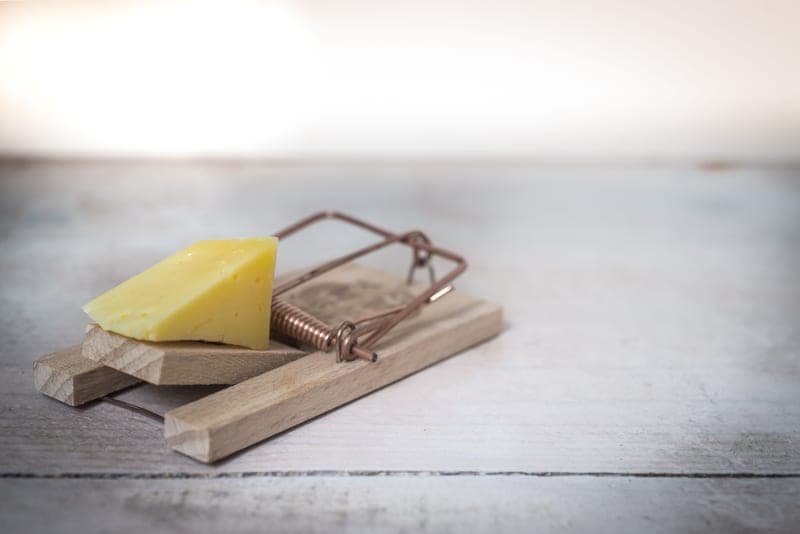 Our pickVictor Metal Pedal Mouse Trap (M150)The wooden snap trap everything else is measured against. Cheap enough to set a dozen, which is how mouse trapping actually works. | Most homes, in quantity | Spring-loaded bar, metal pedal | |
| 2 |  Tomcat Press 'N Set Mouse TrapA plastic snap trap you arm by pressing one tab. If the reason you avoid snap traps is the moment of arming them, this is the fix. | Setting without touching a bar | Plastic jaw, single-press arming | |
| 3 |  Victor Electronic Mouse Trap (M250S)A battery tunnel that delivers a high-voltage shock. You tip the mouse out without seeing or touching it, which is the whole appeal. | No-touch disposal indoors | High-voltage shock inside a tunnel |
#ad — every price link goes to Amazon and Swat & Snap earns a commission on qualifying purchases. No price is shown until it can be pulled live from the retailer.
Victor Metal Pedal Mouse Trap (M150)
Victor · Most homes, in quantity
The wooden snap trap everything else is measured against. Cheap enough to set a dozen, which is how mouse trapping actually works.
- Costs little enough that quantity stops being a decision
- The metal pedal fires on weight, so a mouse cannot lick the bait off
- Nothing to charge, nothing to refill
- You see the result, and you have to handle it
- Exposed bar is a genuine hazard to a dog's nose or a toddler's fingers
Check price on Amazon
Tomcat Press 'N Set Mouse Trap
Tomcat · Setting without touching a bar
A plastic snap trap you arm by pressing one tab. If the reason you avoid snap traps is the moment of arming them, this is the fix.
- One-press arming removes the flinch that makes people set traps badly
- Releases the mouse into a bin without handling
- Plastic jaw loses snap force over many cycles
- Still an open mechanism, so it needs a box in a pet home
Check price on Amazon
Victor Electronic Mouse Trap (M250S)
Victor · No-touch disposal indoors
A battery tunnel that delivers a high-voltage shock. You tip the mouse out without seeing or touching it, which is the whole appeal.
- The tunnel is the safety feature — a dog's nose does not fit the plates
- Indicator light means you are not checking traps blind
- Tip-out disposal, no handling
- Batteries die, usually unnoticed, and a dead trap catches nothing
- Has to sit flat against a wall run or mice walk past it
Check price on Amazon
When peanut butter is not working
If the bait keeps disappearing without a catch, the problem is quantity or placement, not the food. Halve the bait, press it further into the trigger cup, and check the trap is square to the wall with the trigger end against the baseboard — see where to place mouse traps.
If the bait is untouched after three nights, the trap is not on a runway. Move it to where the droppings actually are.
If there is a peanut butter jar open in the kitchen, or a bird feeder nearby, or the house is full of competing food, switch to something the mouse cannot get elsewhere.
The alternatives, and when each one wins
| Bait | When it wins | Notes |
|---|---|---|
| Peanut butter | Default, almost everywhere | Pea-sized, pressed in, smooth not crunchy |
| Cotton wool or dental floss | Cold weather, fall and winter | A mouse gathering nest material has to pull — often better than food |
| Hazelnut spread | Where peanut butter is already abundant | Same stickiness, different smell |
| Bacon grease or a scrap of fat | Garages, sheds, anywhere greasy and cold | Strong smell carries in cold air |
| Chocolate | Sweet-tooth situations; works surprisingly well | Must be pressed in or tied — it is carryable otherwise |
| Oats or seed, stuck in peanut butter | Where mice are feeding on birdseed already | Matches what they are already eating |
| Dried fruit, tied on | Long unattended sets | Does not go rancid the way grease does |
| Cheese | It works, but not better than peanut butter | The cartoon is wrong: cheese is drier and easier to remove |
The winter trick worth knowing
From about September onwards, mice are looking for nesting material as urgently as food. A small wisp of cotton wool, a pinch of dental floss or a strip of tissue tied to the trigger exploits that directly — and because the mouse has to pull rather than lick, the trigger fires reliably.
In an unheated garage or a shed in November, nesting material regularly out-catches peanut butter. It costs nothing to try one trap each way on the same run and see which one goes first.
Bait for electronic traps is a different problem
On an electronic trap, grease is a liability. Peanut butter smeared where it can reach the plates insulates the contacts, and then the trap catches a mouse and does not fire.
- Use a model with a separate bait cup behind the plates if you can.
- If not, bait dry — a few oats, a small piece of chocolate, a nut wedged at the back — and keep grease off the metal entirely.
- Put the bait at the far end, past the plates, never at the mouth. Bait at the entrance teaches the mouse it can feed without stepping in.
Handling and hygiene
Wear disposable gloves when you bait. It is partly about scent — heavily handled traps are approached more cautiously — and mostly about not putting your bare hands where a rodent has been.
Refresh bait every three or four days. Peanut butter dries out and stops smelling, and a dry bait on a correctly placed trap catches nothing while looking perfectly fine.
Wash your hands afterwards, and do not sweep droppings dry when you clean up — CDC guidance is to dampen them with disinfectant first, which is linked below.
What not to bait with
- Anything loose or carryable, unless it is tied on.
- Poison bait in a snap trap. The two methods do not combine usefully, and it adds the disadvantages of both — see mouse trap vs poison.
- Too much of anything. If you can see the bait clearly from three feet away, it is too big.
Frequently asked
Do mice actually like cheese?
How much bait should I put on a mouse trap?
What is the best bait in winter?
Should I wear gloves when baiting mouse traps?
More on mice
One mouse is rarely one mouse. This hub covers what kills them, what only looks like it does, and where to put the thing you buy.
Not sure yet? Read how we pick.
Ryder M.
Ryder M. is the hands-on owner behind Magoo Media Group. He writes Swat & Snap because he got tired of pest-control advice that was either a sales pitch or a scare story.
Related on Swat & Snap
- The best mouse traps, by situationSix traps chosen by situation — cheap and plentiful, pet-safe by design, no-touch, or live catch.

- Where to place mouse trapsHow to read a runway, how to orient a trap, and the three rooms people forget to cover.

- How to get rid of miceThe full sequence: find the runs, trap in quantity, bait small, seal the gaps. Timeline and what to skip.

- The best electronic mouse trapsNo-touch disposal and a tunnel a dog's nose will not fit. Which models survive real use.
- The best rat trap baitWhat rats actually take, how to secure it so they cannot lift it, and why pre-baiting matters more.