The best mouse traps for the kitchen
The kitchen is where you see them and where the trap has the most constraints: food surfaces, children, a dog, and nobody willing to handle the result.
By Ryder M.Published Updated

Swat & Snap earns a commission from qualifying purchases made through the links on this page, at no extra cost to you. It does not change which products we pick — see how we pick and our affiliate disclosure.
What makes a kitchen different
Every other room lets you pick a trap on catch rate alone. A kitchen adds three constraints at once:
- It is a food-preparation surface. Nothing sprayed, nothing that flings debris, and nothing you handle and then touch a countertop.
- It is the busiest room in the house, usually the one with the dog bowl and the toddler in it.
- It is where you will find the result, at seven in the morning, probably barefoot.
That points at the same answer from three directions: an enclosed trap. The mechanism is sealed inside a chamber, the kill is out of sight, the whole unit goes in the bin closed, and nothing is exposed to a paw or a hand. An electronic tunnel trap solves the same problem a different way — the plates sit deep inside a passage a nose cannot enter, and you tip the mouse out without seeing much.
Plain snap traps still belong in a kitchen campaign. They just belong inside the cabinet void and behind the appliances, where nothing else goes, and in a box if a pet can reach them.
Quick picks
| # | Product | Best for | Mechanism | Price |
|---|---|---|---|---|
| 1 |  Our pickVictor Kill Vault Mouse Trap (M267)A snap trap sealed inside a plastic vault. The kill happens out of sight and out of reach, and you never touch the mouse. | Homes with a dog or a toddler | Enclosed snap bar in a sealed chamber | |
| 2 |  Victor Electronic Mouse Trap (M250S)A battery tunnel that delivers a high-voltage shock. You tip the mouse out without seeing or touching it, which is the whole appeal. | No-touch disposal indoors | High-voltage shock inside a tunnel | |
| 3 | 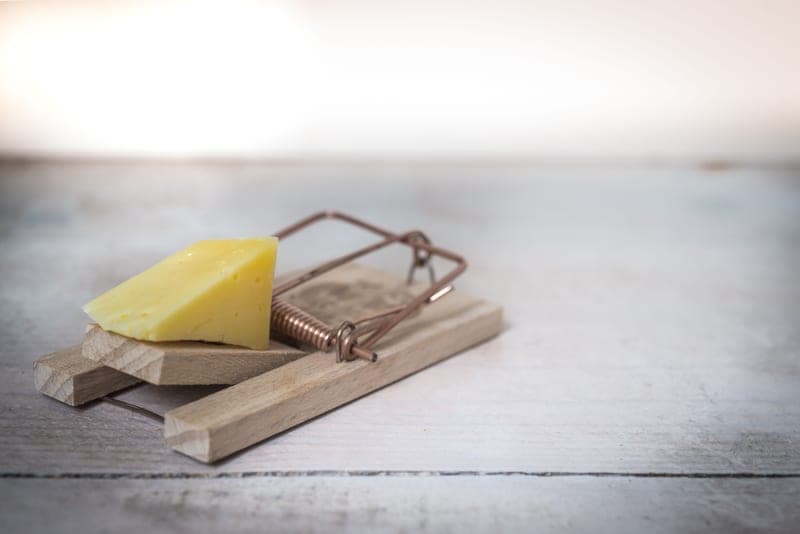 Victor Metal Pedal Mouse Trap (M150)The wooden snap trap everything else is measured against. Cheap enough to set a dozen, which is how mouse trapping actually works. | Most homes, in quantity | Spring-loaded bar, metal pedal | |
| 4 |  Tomcat Press 'N Set Mouse TrapA plastic snap trap you arm by pressing one tab. If the reason you avoid snap traps is the moment of arming them, this is the fix. | Setting without touching a bar | Plastic jaw, single-press arming | |
| 5 |  Owltra OW-4 Electric Mouse TrapWider chamber and a longer battery life than most electronic traps, with a bait cup that keeps peanut butter off the plates. | Repeat catches without resetting | High-voltage shock chamber |
#ad — every price link goes to Amazon and Swat & Snap earns a commission on qualifying purchases. No price is shown until it can be pulled live from the retailer.
Victor Kill Vault Mouse Trap (M267)
Victor · Homes with a dog or a toddler
A snap trap sealed inside a plastic vault. The kill happens out of sight and out of reach, and you never touch the mouse.
- The enclosure is the reason to buy it: a dog cannot get to the bar
- Seals after firing, so there is no smell and nothing to see
- Sets by pressing the lid, not by arming a bar with your fingers
- Single-use, so a real infestation gets expensive
- Bulkier than a bare snap trap in a tight wall run
Check price on Amazon
Victor Electronic Mouse Trap (M250S)
Victor · No-touch disposal indoors
A battery tunnel that delivers a high-voltage shock. You tip the mouse out without seeing or touching it, which is the whole appeal.
- The tunnel is the safety feature — a dog's nose does not fit the plates
- Indicator light means you are not checking traps blind
- Tip-out disposal, no handling
- Batteries die, usually unnoticed, and a dead trap catches nothing
- Has to sit flat against a wall run or mice walk past it
Check price on Amazon
Victor Metal Pedal Mouse Trap (M150)
Victor · Most homes, in quantity
The wooden snap trap everything else is measured against. Cheap enough to set a dozen, which is how mouse trapping actually works.
- Costs little enough that quantity stops being a decision
- The metal pedal fires on weight, so a mouse cannot lick the bait off
- Nothing to charge, nothing to refill
- You see the result, and you have to handle it
- Exposed bar is a genuine hazard to a dog's nose or a toddler's fingers
Check price on Amazon
Tomcat Press 'N Set Mouse Trap
Tomcat · Setting without touching a bar
A plastic snap trap you arm by pressing one tab. If the reason you avoid snap traps is the moment of arming them, this is the fix.
- One-press arming removes the flinch that makes people set traps badly
- Releases the mouse into a bin without handling
- Plastic jaw loses snap force over many cycles
- Still an open mechanism, so it needs a box in a pet home
Check price on Amazon
Owltra OW-4 Electric Mouse Trap
Owltra · Repeat catches without resetting
Wider chamber and a longer battery life than most electronic traps, with a bait cup that keeps peanut butter off the plates.
- USB-C power option removes the dead-battery failure mode
- The bait cup stops grease fouling the contacts, which is what kills cheap electronic traps
- Bigger footprint than a snap trap — awkward behind an appliance
- Costs several snap traps, and mouse control wants numbers
Check price on Amazon
The three placements that catch almost everything
1. Behind and underneath the refrigerator. The single most productive spot in most houses — warm, dark, undisturbed, and there are crumbs. If you set two traps in a kitchen, both go here.
2. Inside the kickboard void. The space under base cabinets is a mouse motorway: enclosed, warm, and directly connected to the wall cavity. Most kickboards unclip in seconds. Put two traps in and leave them.
3. The back wall of base cabinets and the pantry, at floor level, behind whatever is stored there.
After those: behind the stove, under the sink around the pipe penetrations, and the gap behind the dishwasher. Where to place mouse traps has the full room-by-room map.
Perpendicular to the wall, trigger end touching the baseboard. A trap set parallel gets walked past.
Baiting in a room full of food
A kitchen is the hardest place to compete on bait, because the mouse already has options. Two adjustments:
- Keep it small and sticky. A pea of peanut butter pressed into the trigger, not a blob it can feed around.
- Cut the competition first. Dry goods into glass or metal, crumbs swept from under the appliances, pet food up overnight, bin lids closed. The mice came for something, and a trap competing with an open bag of rice loses.
Hygiene, which matters more here than anywhere
- Wear disposable gloves to set, check and dispose.
- Never sweep or vacuum droppings dry. Public health guidance is to dampen them with a disinfectant solution, leave it five minutes, then lift with paper towel and bag it — dry sweeping puts particles into the air. The CDC guidance is linked below.
- Wash any surface a mouse may have crossed, and wash your hands afterwards.
- Do not use aerosol insecticide or rodent bait anywhere near a food surface.
What not to use in a kitchen
Poison. A poisoned mouse dies inside the wall cavity of the room you cook in, and the smell lasts weeks with no way to reach it. Mouse trap vs poison makes the full case.
Glue boards, other than as a monitoring tool you lift the next morning. Snap trap vs glue trap.
An open snap trap on the floor in a house with a dog or a small child. Use the enclosed version instead — that is what it is for.
When the kitchen is clear
Five consecutive nights with no catches on baited traps that are still on the runs means the trapping is done. Then seal: the gap around pipes under the sink, the hole where a cable enters a cupboard, and every gap above 6 mm on the outside of the building. How to get rid of mice covers the whole sequence.
Frequently asked
What is the best mouse trap for a kitchen?
Where do you put mouse traps in a kitchen?
Is it safe to use mouse traps near food?
How do I clean up after mice in the kitchen?
More on mice
One mouse is rarely one mouse. This hub covers what kills them, what only looks like it does, and where to put the thing you buy.
Not sure yet? Read how we pick.
Ryder M.
Ryder M. is the hands-on owner behind Magoo Media Group. He writes Swat & Snap because he got tired of pest-control advice that was either a sales pitch or a scare story.
Related on Swat & Snap
- The best mouse traps, by situationSix traps chosen by situation — cheap and plentiful, pet-safe by design, no-touch, or live catch.
- Where to place mouse trapsHow to read a runway, how to orient a trap, and the three rooms people forget to cover.

- Pet-safe mouse trapsEnclosed and tunnel traps that are safe because of their geometry, plus a free way to make any trap safer.

- How to get rid of miceThe full sequence: find the runs, trap in quantity, bait small, seal the gaps. Timeline and what to skip.

- The best mouse trap baitPeanut butter, pea-sized and pressed in. What to switch to when that stops working, and the winter trick.

- The best mouse traps for small miceSensitive triggers for juvenile and small mice, plus the bait change that matters more than the trap.