What is in fruit fly traps?
The liquid is the product. Almost every lure trap on the shelf contains a food-based fermentation attractant rather than an insecticide, which is why they are safe on a worktop and also why they only catch adults.
By Ryder M.Published Updated

Swat & Snap earns a commission from qualifying purchases made through the links on this page, at no extra cost to you. It does not change which products we pick — see how we pick and our affiliate disclosure.
Why the ingredient is a food, not a poison
Fruit flies find food by smell. A female Drosophila is tuned to the volatile compounds released when fruit ferments — ethanol, acetic acid, esters — because that is where she lays eggs. Nothing synthetic improves on that, so the sensible design for a trap is to recreate the smell of rotting fruit and give the fly no way out.
That has two consequences worth understanding before you buy.
First, these are lure-and-drown devices, not insecticides. Most consumer fruit fly traps work mechanically: the fly goes in through an entry sized for it, lands on or falls into a liquid, and cannot climb back out. No active ingredient is required, which is why the labels are short and there is no re-entry interval.
Second, the lure has to out-smell your kitchen. A lure competing with an open fruit bowl loses, because real fermenting fruit is a stronger signal than any simulation of it. This is the single biggest practical reason traps appear not to work — we go into it in do fruit fly traps work.
What is in each type
Based on each product's own stated ingredients and mechanism.
| Trap | What is inside | Active insecticide | How the fly dies |
|---|---|---|---|
| TERRO Fruit Fly Trap | Liquid food-based fermentation lure in a sealed apple-shaped housing | None stated | Drowns in the lure |
| Raid Essentials Fruit Fly Trap | Liquid food-based lure, sealed housing | None stated | Drowns in the lure |
| Aunt Fannie's FlyPunch | Food-grade liquid lure; malic acid plus food ingredients, open jar | None — food-grade ingredients | Drowns in the lure |
| Zevo Flying Insect Trap | No liquid; blue and UV light over a sticky cartridge | None in the trap itself | Held on the adhesive |
| Homemade vinegar trap | Cider vinegar, a drop of dish soap | None | Soap breaks surface tension; the fly sinks |
Two things stand out from that table.
Malic acid comes up repeatedly because it is the dominant acid in apples. A lure built around it smells like apple going over, which is precisely the cue the fly is looking for. Aunt Fannie's states it explicitly; most sealed traps describe their lure only as a food-based attractant and do not publish the formula.
Light traps are a different mechanism. A plug-in trap with a sticky cartridge is not using a smell at all — it is using light to draw insects onto adhesive. That makes it broader-spectrum (it catches gnats and small flies a vinegar lure ignores) and weaker specifically on fruit flies, which are far more responsive to fermentation than to light. Best plug-in fly traps covers that category and its cartridge running costs.
Is any of it toxic?
For a lure trap, the honest answer is: there is no insecticide in it, and the ingredients are food-grade or close to it. That is the main reason this product can sit next to a chopping board.
Which does not mean "drink it":
- It is not food, even where the ingredients are food-grade. Keep it where a toddler cannot get the lid off, and bin spent traps rather than leaving them on a low shelf.
- A sealed trap is the better choice around pets and children than an open jar, because the liquid cannot be knocked over or lapped at. Several of the picks on this page are sealed for exactly that reason, and pet-safe fly traps is the dedicated page if that is your deciding factor.
- Sticky cartridges in light traps are adhesive, not poison, but they are unpleasant on fur. Mount a plug-in trap where the cat cannot reach the cartridge.
- Read the label if the product says it kills. Anything marketed as killing flying insects on contact contains an active ingredient — a pyrethroid or a botanical oil — and is a spray, not a trap. Different product, different precautions.
What to look for
"Food-based lure" or "food-grade ingredients" on the label. That is the phrase that tells you it is a lure-and-drown trap rather than a treated device.
A sealed housing where it is going on a worktop. It will not spill and nothing can get into the liquid.
An open jar only if you want zero assembly and the trap is somewhere stable and out of reach.
A stated service life. Nearly all of these run about 30 days and are then replaced whole — there is no refill. Multi-packs are the sensible buy because you want one by the bin and one by the fruit bowl.
A light trap only as a background supplement. It catches a broader mix passively, which suits a room you do not want to think about, and the cartridge cost adds up quickly.
No insecticide, for a kitchen. On a surface where food is prepared, the lure trap is the right category and an aerosol is not.
Quick picks
| # | Product | Best for | Mechanism | Price |
|---|---|---|---|---|
| 1 | 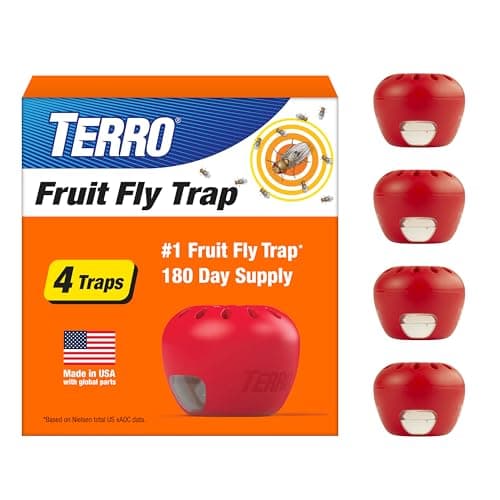 Our pickTERRO Fruit Fly Trap, 4-Pack (T2503SR)An apple-shaped lure trap that works because the liquid inside is a real fermentation attractant, not because of the shape. | Kitchen counters | Liquid food-based lure | $12.19$15.9924% offView on Amazon Price as of October 17, 2026 |
| 2 | 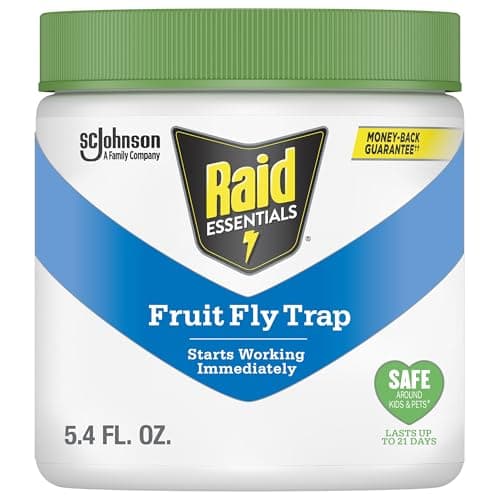 Raid Essentials Fruit Fly TrapA sealed liquid lure trap that does the same job as the better-known apple-shaped one, usually for less. The lure is the product; the housing is just a housing. | A cheaper sealed lure trap | Liquid food-based lure | $7.01View on Amazon Price as of October 17, 2026 |
| 3 | 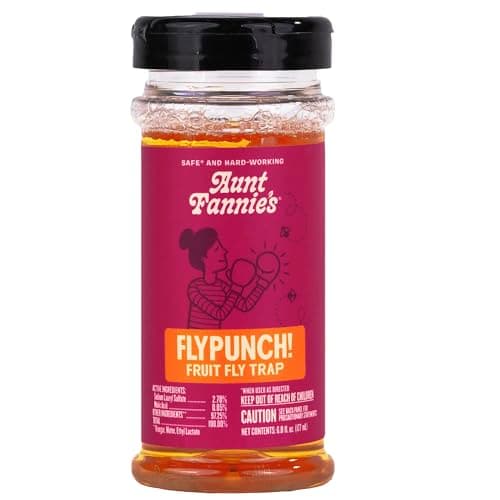 Aunt Fannie's FlyPunch Fruit Fly TrapA jar of food-grade lure you open and leave out. Less tidy than a sealed trap, and the fastest thing here to deploy. | Open-lid simplicity | Food-grade liquid lure, open jar | $7.96View on Amazon Price as of October 17, 2026 |
| 4 | 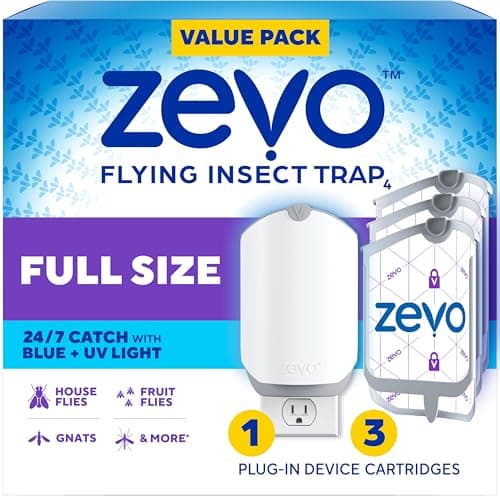 Zevo Flying Insect TrapA plug-in that pairs blue and UV light with a sticky cartridge. It runs quietly in the background, which is exactly what people want from a fly problem. | Rooms you want handled passively | Blue + UV light, sticky cartridge | $25.96View on Amazon Price as of October 17, 2026 |
#ad — every price link goes to Amazon and Swat & Snap earns a commission on qualifying purchases. Prices are pulled live from the retailer; where one is not available the button reads “Check price on Amazon” rather than showing a stale number.
TERRO Fruit Fly Trap, 4-Pack (T2503SR)
Terro · Kitchen counters
An apple-shaped lure trap that works because the liquid inside is a real fermentation attractant, not because of the shape.
- The lure outperforms homemade vinegar in a side-by-side on the same counter
- Sealed, so there is no open dish of vinegar to knock over
- Catches flies; does nothing about the drain or bin that is breeding them
- Thirty days and it is done — no refill
Raid Essentials Fruit Fly Trap
Raid · A cheaper sealed lure trap
A sealed liquid lure trap that does the same job as the better-known apple-shaped one, usually for less. The lure is the product; the housing is just a housing.
- Sealed, so there is no open dish of vinegar to knock over on a worktop
- Widely stocked, which matters when you want it today rather than Thursday
- Catches adults only — the drain or bin breeding them is untouched
- Thirty days and it is spent, with no refill option
Aunt Fannie's FlyPunch Fruit Fly Trap
Aunt Fannie's · Open-lid simplicity
A jar of food-grade lure you open and leave out. Less tidy than a sealed trap, and the fastest thing here to deploy.
- Ingredients are food-grade, which matters on a counter where you prep
- Peel the lid, done — no assembly
- Open jar spills if it is knocked
- Again, catches adults without touching the breeding site
Zevo Flying Insect Trap
Zevo · Rooms you want handled passively
A plug-in that pairs blue and UV light with a sticky cartridge. It runs quietly in the background, which is exactly what people want from a fly problem.
- No zapping noise and no insect debris — it is a sticky pad behind a light
- Catches gnats and small flies that a vinegar trap ignores
- Cartridges are an ongoing cost that outruns the unit price fast
- Needs a dark room to compete with daylight
What is in a homemade one, and does it match
If you would rather mix it yourself, the recipe is short because the chemistry is simple:
- Apple cider vinegar — supplies the acetic acid and the fermentation smell. Red wine, balsamic or the dregs of a beer all work for the same reason.
- A piece of over-ripe fruit, optional, which adds the ester notes vinegar alone lacks.
- One drop of dish soap — this is the part people miss. Without it, the fly stands on the surface tension and flies away. The soap makes the liquid wet the insect so it sinks.
- A cover with small holes, or nothing at all. A funnel of paper works; so does plastic film pricked with a fork.
That genuinely works, and it costs nothing. In a side-by-side on the same counter, commercial lures generally out-catch it — the formulations are tuned — and a sealed trap is tidier where there is a cat or a toddler. DIY vs store-bought fruit fly traps is the full comparison, and fruit fly trap bait goes deeper on what to put in a homemade one.
What the lure cannot do
Worth repeating, because it is the thing that decides whether you are still dealing with flies in a fortnight: none of these ingredients touch eggs or larvae. The lure attracts adults. The eggs are in the drain film, the bin, the fruit, the recycling or the potting soil, and they hatch on their own schedule — about 8 to 10 days from egg to adult at room temperature.
So the lure is the mop. The fix is finding the breeding site, cleaning the drain mechanically with a brush rather than a pour-in product, washing the bin and lid, and getting the fruit into the refrigerator for a week. How to get rid of fruit flies is the sequence, and what attracts fruit flies is what brought them in.
The short version
The liquid in a fruit fly trap is a food-based fermentation lure — sugars, vinegar or acetic acid derivatives, often malic acid, sometimes a wetting agent — and in nearly every consumer trap there is no insecticide at all. The fly is lured in and drowns. That makes these traps safe to use beside food and useless against eggs and larvae, which is the whole reason a trap has to be paired with cleaning the drain and the bin. Light traps are the exception: adhesive cartridge, no lure, broader catch, higher running cost.
Frequently asked
What is the liquid in a fruit fly trap?
Are fruit fly traps toxic?
What is in a TERRO fruit fly trap?
Is malic acid what attracts fruit flies?
What can I put in a homemade fruit fly trap?
Do fruit fly traps contain pesticide?
More on fruit flies & gnats
Tiny flies in the kitchen are almost never one problem. Identify which of the three you have, then treat the source — the trap alone never finishes it.
Not sure yet? Read how we pick.
Ryder M.
Ryder M. is the hands-on owner behind Magoo Media Group. He writes Swat & Snap because he got tired of pest-control advice that was either a sales pitch or a scare story.
Related on Swat & Snap
- Fruit fly trap baitCider vinegar, wine, overripe fruit — what pulls fruit flies in, and the soap trick that makes it a trap.
- The best fruit fly trapsLure traps, plug-in lights and sticky stakes, matched to where the flies actually are.
- Do fruit fly traps actually work?What lure traps genuinely do, the three reasons they appear to fail, and the source-removal step that ends it.
- DIY vs store-bought fruit fly trapsCider vinegar and dish soap versus a commercial lure — what each is actually better at.
- What attracts fruit fliesThe full checklist of breeding sites, ranked by how often each one turns out to be the answer.
- Pet-safe fly trapsSealed lure traps and enclosed light traps that a curious cat cannot spill, drink or stick to.