Do fruit fly traps actually work?
Yes — on adults, within a few feet, over a few days. The reason people think they do not is that the trap is only half the job, and the other half is a drain or a bin nobody looked in.
By Ryder M.Published Updated
Swat & Snap earns a commission from qualifying purchases made through the links on this page, at no extra cost to you. It does not change which products we pick — see how we pick and our affiliate disclosure.
What a fruit fly trap actually does
A liquid lure trap is a small container of fermentation attractant with an entry the fly can find and an exit it cannot. The lure is the product; the apple-shaped housing is decoration. Adult fruit flies locate rotting fruit by smell, they fly toward it, they go in, and they do not come out.
That works. On a counter next to the fruit bowl, a decent lure trap will show a visible catch within 24 to 48 hours, and in a side-by-side on the same worktop a commercial lure generally outperforms homemade cider vinegar — which is the main reason to buy one rather than make one. DIY vs store-bought fruit fly traps has that comparison in full.
So the honest version of the answer is not "traps don't work". It is: traps do exactly one thing well, and that thing is removing adults within a small radius.
What they cannot do
They do not touch the eggs or larvae. A female fruit fly lays several hundred eggs over her life, on or just under the surface of fermenting material. Those eggs are in the drain slime, in the bin, in the fruit, in the wet potting soil — not in your trap. Catching the adult after she has laid is closing the gate after the event.
They do not reach across a room. A lure trap is a short-range device. Flies have to smell it from where they already are, which means a trap in the living room is doing nothing about the drain in the kitchen. Place it within a few feet of the source.
They do not compete with a stronger smell. A trap next to an open bin, a bowl of over-ripe bananas or a sink full of dishes is losing. The actual fermenting material is a better lure than anything you can buy, and the flies will choose it.
They do not work on every small fly. If it is not a fruit fly, a fruit fly lure is the wrong product. Fungus gnats come from houseplant soil and ignore vinegar lures almost entirely; drain flies are fuzzy and come out of the drain itself. Gnats vs fruit flies vs drain flies is the identification page, and it is worth five minutes before you buy anything — and do fruit fly traps work for gnats answers the specific crossover question.
The three reasons a trap seems to fail
1. The breeding site is still there. This accounts for most of it. The life cycle runs about 8 to 10 days at normal room temperature from egg to adult, so a source you have not found produces a fresh wave roughly weekly, indefinitely. You will catch flies every day and never see fewer of them.
2. It is competing with something better. The trap is on the counter, and a dish of over-ripe peaches is two feet away. Remove the competition and the catch rate jumps.
3. It is the wrong insect. Fungus gnats around the houseplants, drain flies on the bathroom wall, phorid flies from a broken waste pipe. All three get mistaken for fruit flies, and a fruit fly lure does little for any of them.
What to look for
A liquid food-based lure, not a scent card. Fermentation attractant is what works on Drosophila. Products that rely purely on light or a sticky card catch fewer fruit flies and more of everything else.
Sealed, if it is going on a worktop. An open jar of lure spills. A sealed trap with a small entry is the better choice where you prep food or where a cat might investigate.
About a 30-day service life, and no refill. Nearly every lure trap on the market is spent in a month and is replaced whole rather than refilled. Buy a multi-pack: you want one beside the bin and one beside the fruit bowl, not one in the middle of the kitchen.
Food-grade ingredients where it matters. On a counter where you prepare food, a trap whose lure is food-grade is a reasonable thing to pay slightly more for.
A light trap only as a supplement. A plug-in light-and-sticky-card trap catches a broader mix of small flying insects passively and is good in a room you want handled in the background. It is not better than a lure trap on fruit flies specifically, and the cartridges are an ongoing cost.
Nothing that promises to end an infestation. No trap does. The ones that work are honest that they catch adults.
Quick picks
| # | Product | Best for | Mechanism | Price |
|---|---|---|---|---|
| 1 | 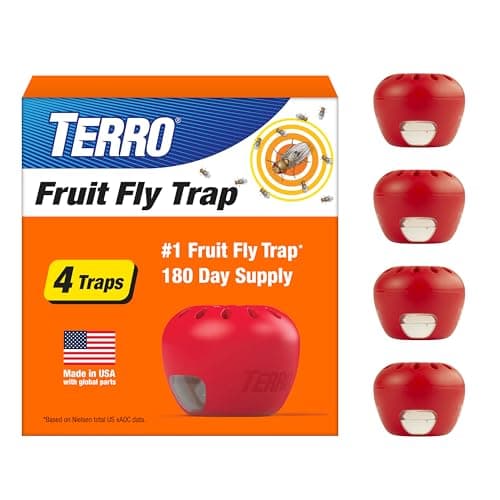 Our pickTERRO Fruit Fly Trap, 4-Pack (T2503SR)An apple-shaped lure trap that works because the liquid inside is a real fermentation attractant, not because of the shape. | Kitchen counters | Liquid food-based lure | $12.19$15.9924% offView on Amazon Price as of October 17, 2026 |
| 2 | 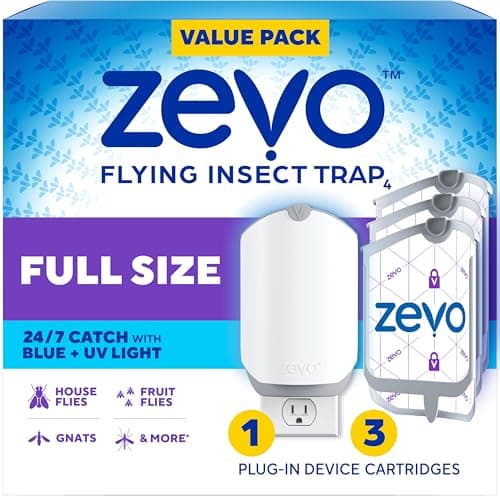 Zevo Flying Insect TrapA plug-in that pairs blue and UV light with a sticky cartridge. It runs quietly in the background, which is exactly what people want from a fly problem. | Rooms you want handled passively | Blue + UV light, sticky cartridge | $25.96View on Amazon Price as of October 17, 2026 |
| 3 | 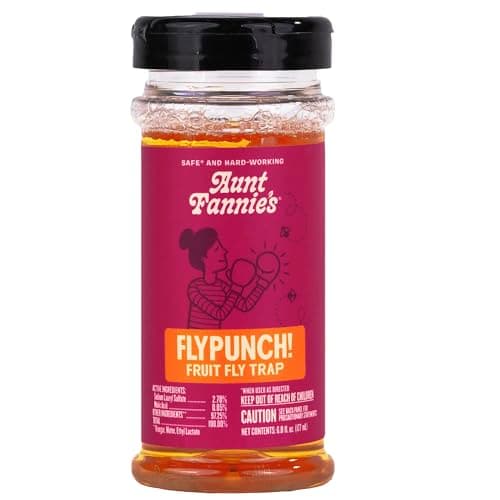 Aunt Fannie's FlyPunch Fruit Fly TrapA jar of food-grade lure you open and leave out. Less tidy than a sealed trap, and the fastest thing here to deploy. | Open-lid simplicity | Food-grade liquid lure, open jar | $7.96View on Amazon Price as of October 17, 2026 |
#ad — every price link goes to Amazon and Swat & Snap earns a commission on qualifying purchases. Prices are pulled live from the retailer; where one is not available the button reads “Check price on Amazon” rather than showing a stale number.
TERRO Fruit Fly Trap, 4-Pack (T2503SR)
Terro · Kitchen counters
An apple-shaped lure trap that works because the liquid inside is a real fermentation attractant, not because of the shape.
- The lure outperforms homemade vinegar in a side-by-side on the same counter
- Sealed, so there is no open dish of vinegar to knock over
- Catches flies; does nothing about the drain or bin that is breeding them
- Thirty days and it is done — no refill
Zevo Flying Insect Trap
Zevo · Rooms you want handled passively
A plug-in that pairs blue and UV light with a sticky cartridge. It runs quietly in the background, which is exactly what people want from a fly problem.
- No zapping noise and no insect debris — it is a sticky pad behind a light
- Catches gnats and small flies that a vinegar trap ignores
- Cartridges are an ongoing cost that outruns the unit price fast
- Needs a dark room to compete with daylight
Aunt Fannie's FlyPunch Fruit Fly Trap
Aunt Fannie's · Open-lid simplicity
A jar of food-grade lure you open and leave out. Less tidy than a sealed trap, and the fastest thing here to deploy.
- Ingredients are food-grade, which matters on a counter where you prep
- Peel the lid, done — no assembly
- Open jar spills if it is knocked
- Again, catches adults without touching the breeding site
The step that finishes it
This is the half of the job the traps cannot do. Work through it in this order.
- Find the breeding site. It is wet, organic and fermenting. In order of likelihood: the kitchen sink drain and the garbage disposal, the bin (including the lid rim and the bottom under the bag), over-ripe fruit in a bowl or at the back of a cupboard, a forgotten potato or onion, the recycling with unrinsed bottles and cans, a mop bucket or cleaning cloth, a drip tray under the refrigerator, and overwatered houseplant soil.
- Clean the drain mechanically. Pour a kettle of boiling water down, then scrub the inside of the drain and the underside of the strainer with a bottle brush — the breeding material is a film on the wall of the pipe, not standing water, so a chemical poured through does less than a brush. An enzyme drain cleaner left overnight helps. Drain flies in the sink is the dedicated method.
- Empty and wash the bin, including the rim and lid, and line it.
- Refrigerate or bin the fruit for a week. All of it. This is the step that feels excessive and is the most effective single action.
- Rinse recycling before it goes in the bin.
- Let houseplant soil dry out between waterings if gnats are part of the picture. Fungus gnats in houseplants.
- Then run the traps to mop up the adults still flying, for about a week.
Do that and the population collapses within one life cycle, because you have removed the thing generating it. How to get rid of fruit flies is the full sequence, and what attracts fruit flies covers what brought them in.
So should you buy one?
Yes, with the right expectation.
Buy a trap if you want the flying adults gone from a kitchen while you deal with the source, you want to know whether the source is in the kitchen or the bathroom (put a trap in each and compare catches after two days), or you have a recurring seasonal problem and want something on standby.
Do not buy a trap if you expect it to be the whole answer, or if what you actually have is fungus gnats in houseplant soil or drain flies on a bathroom wall — in both cases there is a better-targeted product.
Used as monitoring, a trap is genuinely informative: two traps in different rooms will tell you within 48 hours where your breeding site is, and that is worth the price of the pack on its own.
The short version
Fruit fly traps work on adult flies, within a few feet, over a few days, and a commercial liquid lure beats homemade vinegar on the same counter. They do nothing about the eggs and larvae in your drain, your bin or your fruit bowl, which is why they appear to fail. Find and clean the breeding site, bin or refrigerate the fruit for a week, and run the traps alongside it. Source removal ends the problem; the trap just clears the air while you do it.
Frequently asked
Do fruit fly traps actually work?
How long does it take for a fruit fly trap to work?
Why are there still fruit flies with a trap out?
Are store-bought fruit fly traps better than vinegar?
Where should I put a fruit fly trap?
Do fruit fly traps work on gnats and drain flies?
More on fruit flies & gnats
Tiny flies in the kitchen are almost never one problem. Identify which of the three you have, then treat the source — the trap alone never finishes it.
Not sure yet? Read how we pick.
Ryder M.
Ryder M. is the hands-on owner behind Magoo Media Group. He writes Swat & Snap because he got tired of pest-control advice that was either a sales pitch or a scare story.
Related on Swat & Snap
- The best fruit fly trapsLure traps, plug-in lights and sticky stakes, matched to where the flies actually are.
- How to get rid of fruit fliesSource first, trap second. The full 48-hour sequence and the hiding places people always miss.
- What is in fruit fly traps?What the liquid inside a fruit fly trap actually is, which brands use what, and whether any of it is toxic.
- Gnats vs fruit flies vs drain fliesBehavior, not anatomy: the one-minute test that tells you which tiny fly you have.
- DIY vs store-bought fruit fly trapsCider vinegar and dish soap versus a commercial lure — what each is actually better at.
- Fruit fly trap baitCider vinegar, wine, overripe fruit — what pulls fruit flies in, and the soap trick that makes it a trap.