How long does it take to get rid of fruit flies?
Two to three days to see a real drop, about a week to be mostly done, up to two weeks to be finished — provided you found the breeding site. If you only put out traps, the clock never starts, and that is the single reason this drags on for people.
By Ryder M.Published Updated
Swat & Snap earns a commission from qualifying purchases made through the links on this page, at no extra cost to you. It does not change which products we pick — see how we pick and our affiliate disclosure.
The life cycle is the timeline
Everything about how long this takes comes from one fact: in a warm kitchen a fruit fly gets from egg to flying adult in about a week. Females lay in batches on anything fermenting, and the whole cycle runs on temperature — warm rooms speed it up, a cold snap slows it down.
That gives you the arithmetic for the entire problem.
- Adults you can see today are a week old or less, and they live a few weeks.
- Eggs already laid today will hatch into adults you can see in roughly a week, whatever you do about the adults.
- Removing the source today stops new eggs, but does not cancel the ones already in the pipeline.
So the fastest honest answer is: the adults can be knocked down in days, but you cannot be finished faster than the generation already laid takes to emerge and die off. That is the week-to-two-weeks figure, and nothing sold in a shop shortens it.
The day-by-day timeline
Day 1 — find and remove the source. This is the entire job and the rest is cleanup. Fruit flies breed in fermenting organic matter, not in the air, so there is a physical thing in your kitchen producing them. Check, in this order: the fruit bowl, the bag of potatoes or onions at the back of the cupboard, the recycling bin, the kitchen sink drain, the garbage disposal, the drip tray under the refrigerator, the mop bucket, the dishcloth, the bin itself, and any spill under a cabinet. Open containers of beer, wine or vinegar count too. What attracts fruit flies is the complete list.
Put traps out the same day. They work on the adults while the population stops being replaced.
Day 2 to 3 — the first real drop. You should see clearly fewer flies by now. Traps fill fastest in the first forty-eight hours because the standing adult population is at its peak and hungry. If nothing has changed at all by day three, the source is still there — go back to day one rather than buying a second trap.
Day 4 to 7 — the long middle. Numbers fall steadily. This is also when the eggs laid before you cleaned up start emerging, so you may see a small bump rather than a smooth decline. That bump is normal and it is not a failure; it is the last generation arriving on schedule. Keep the traps out and keep the counters dry.
Day 7 to 14 — stragglers. A handful of flies, usually around the sink or the bin rather than the fruit bowl. Each one is a survivor rather than a sign of active breeding. Traps mop these up. If the numbers are genuinely falling week on week, you are finished and just waiting.
Past day 14 — something is still breeding. This is the line. A properly sourced outbreak is over inside two weeks. If it is not, there is a second site you have not found, and ninety percent of the time it is a drain.
Why traps alone take forever
A trap catches adults. It does nothing to eggs and larvae, which are the part of the population you cannot see.
While a breeding site is active, it produces a new cohort roughly every week, indefinitely. A trap running against that is bailing a boat with the hole still open — it keeps the numbers down and it never ends the problem. This is why people report running traps for a month with no real progress, and it is not the trap's fault.
The reverse is also true and worth saying plainly: remove the source and the problem ends even with no traps at all, just more slowly and with more flies in the room while you wait. Traps shorten the unpleasant middle. The clean-up ends it.
The right way to use both is together, from day one. How to get rid of fruit flies covers the homemade cider-vinegar trap against the commercial lures, and do fruit fly traps work is the honest verdict on what a trap can and cannot do.
Quick picks
| # | Product | Best for | Mechanism | Price |
|---|---|---|---|---|
| 1 | 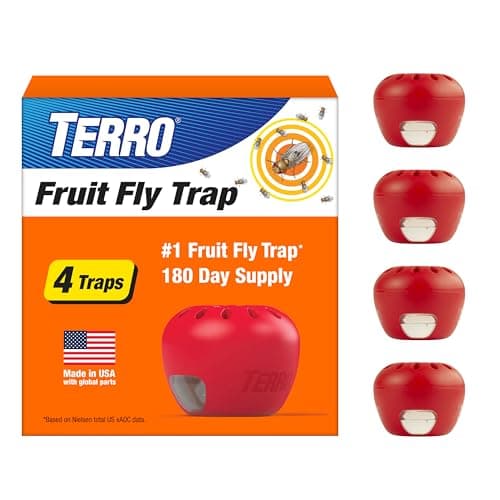 Our pickTERRO Fruit Fly Trap, 4-Pack (T2503SR)An apple-shaped lure trap that works because the liquid inside is a real fermentation attractant, not because of the shape. | Kitchen counters | Liquid food-based lure | $12.19$15.9924% offView on Amazon Price as of November 11, 2026 |
| 2 | 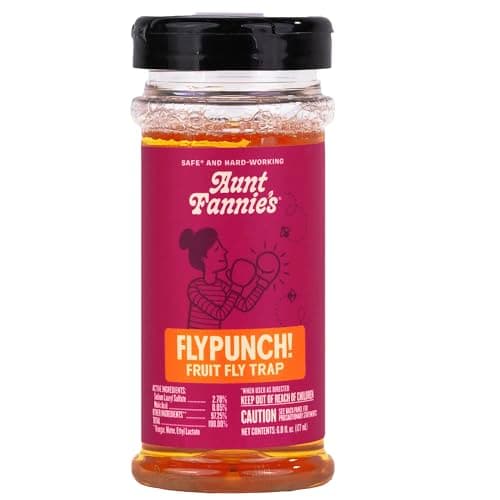 Aunt Fannie's FlyPunch Fruit Fly TrapA jar of food-grade lure you open and leave out. Less tidy than a sealed trap, and the fastest thing here to deploy. | Open-lid simplicity | Food-grade liquid lure, open jar | $7.96View on Amazon Price as of November 11, 2026 |
| 3 | 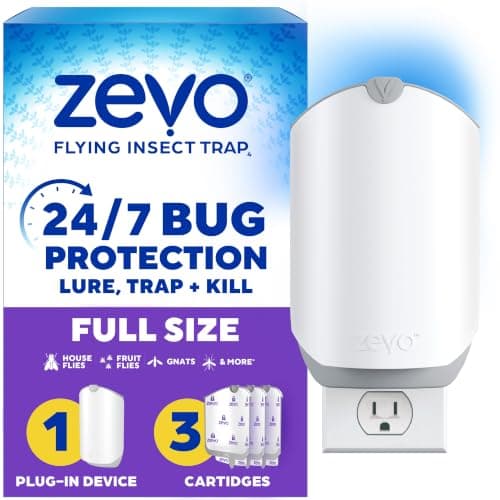 Zevo Flying Insect TrapA plug-in that pairs blue and UV light with a sticky cartridge. It runs quietly in the background, which is exactly what people want from a fly problem. | Rooms you want handled passively | Blue + UV light, sticky cartridge | $25.96View on Amazon Price as of November 11, 2026 |
| 4 | 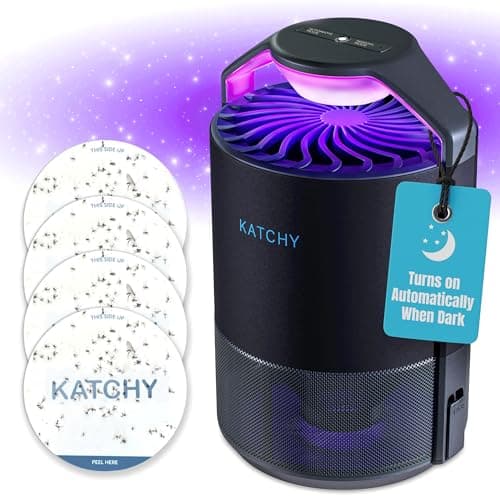 Katchy Midnight Indoor Insect TrapUV light, a small fan and a sticky pad. The fan is what makes it work on gnats — they are weak fliers and get pulled in. | Fungus gnats around plants | UV light + suction fan + glue board | $49.99View on Amazon Price as of November 11, 2026 |
#ad — every price link goes to Amazon and Swat & Snap earns a commission on qualifying purchases. Prices are pulled live from the retailer; where one is not available the button reads “Check price on Amazon” rather than showing a stale number.
TERRO Fruit Fly Trap, 4-Pack (T2503SR)
Terro · Kitchen counters
An apple-shaped lure trap that works because the liquid inside is a real fermentation attractant, not because of the shape.
- The lure outperforms homemade vinegar in a side-by-side on the same counter
- Sealed, so there is no open dish of vinegar to knock over
- Catches flies; does nothing about the drain or bin that is breeding them
- Thirty days and it is done — no refill
Aunt Fannie's FlyPunch Fruit Fly Trap
Aunt Fannie's · Open-lid simplicity
A jar of food-grade lure you open and leave out. Less tidy than a sealed trap, and the fastest thing here to deploy.
- Ingredients are food-grade, which matters on a counter where you prep
- Peel the lid, done — no assembly
- Open jar spills if it is knocked
- Again, catches adults without touching the breeding site
Zevo Flying Insect Trap
Zevo · Rooms you want handled passively
A plug-in that pairs blue and UV light with a sticky cartridge. It runs quietly in the background, which is exactly what people want from a fly problem.
- No zapping noise and no insect debris — it is a sticky pad behind a light
- Catches gnats and small flies that a vinegar trap ignores
- Cartridges are an ongoing cost that outruns the unit price fast
- Needs a dark room to compete with daylight
Katchy Midnight Indoor Insect Trap
Katchy · Fungus gnats around plants
UV light, a small fan and a sticky pad. The fan is what makes it work on gnats — they are weak fliers and get pulled in.
- The fan catches fungus gnats that simply ignore a light-only trap
- USB power means it can sit on a plant shelf with no socket nearby
- Needs the room dark to compete with a window
- Glue boards fill quickly in a real gnat bloom
Which trap suits which stage
The traps are not interchangeable across the two weeks, and matching them to the stage is the one place a purchase genuinely shortens the timeline.
Days 1 to 3, peak adult numbers. You want volume and you want it cheap, because this is the stage where the catch rate is highest and the flies are everywhere rather than in one place. Several small lure traps distributed around the kitchen — one by the bin, one by the sink, one by the fruit bowl — beat a single better trap in a single spot. A cider-vinegar bowl alongside them costs nothing and adds real capacity.
Days 4 to 14, the decline. Numbers drop and the flies concentrate near whatever moisture is left, usually the sink and the bin. Here a sealed liquid lure earns its place: it keeps working for weeks without attention, it cannot be knocked over onto a counter you prepare food on, and you are no longer emptying anything daily.
Every summer, permanently. If this is an annual event rather than a one-off, the useful purchase is something that runs continuously and that you never think about — a plug-in UV and glue-card unit near the bin, or a lure trap replaced a few times a year. The point of a permanent trap is not to clear an outbreak, it is to tell you one is starting while it is still three flies.
The case against upgrading mid-outbreak. If day three looks like day one, a better trap will not fix it. The problem is a breeding site, and spending more on the adult-catching half of the job while the production half runs untouched is the single most common way people spend money on this and stay frustrated.
When it is taking longer than it should
Run through these in order. They account for almost every outbreak that passes the two-week mark.
It is the drain. The commonest hidden site by a wide margin. A film of organic sludge on the inside of the pipe is a perfect nursery, it is invisible, and pouring bleach down does not reliably remove it because the bleach runs straight past. You need mechanical cleaning — a stiff brush down the pipe — or an enzyme drain treatment that digests the film. Tape a piece of clear plastic sticky-side-down over the drain overnight: if flies are stuck to it in the morning, you have your answer. Drain flies in the sink covers the related pest that lives in exactly the same place.
It is not fruit flies. Tiny flies drifting up off houseplant soil are fungus gnats, and no amount of kitchen cleaning touches them — that is a houseplant watering problem. Fuzzy, moth-like flies sitting still on the wall near a sink are drain flies. Telling the three apart takes about a minute and saves a fortnight.
The source is outside the kitchen. A bathroom sink, a utility-room floor drain, a basement sump, a wet mop head in a closet, a forgotten glass in a bedroom, a pet's water bowl area, the bottom of a laundry hamper.
They are coming in from outside. A compost heap, a bin store or a neighbor's recycling by an open window will supply a kitchen indefinitely. In that case you are not clearing an infestation, you are managing an influx — screens and a trap by the window are the realistic answer. Gnats outside covers the outdoor side.
The recycling is the site and you keep refilling it. Rinsing bottles and cans before they go in the bin is unglamorous and it is often the whole fix.
Someone is leaving fruit out. A single over-ripe banana restarts the clock as fast as you can clear it.
Speeding it up, honestly
You cannot beat the life cycle, but you can compress the ugly part.
- Do the source removal properly on day one rather than spreading it over a week. Half a clean-up gives you half a result on a full timeline.
- Use more than one trap, placed within a foot of where the flies actually are, not where it is tidy to put them. Two traps near the bin and the sink beat one on the windowsill.
- Keep surfaces dry. Fruit flies need moisture and fermentation; a dry counter and an empty sink are hostile.
- Refrigerate ripe fruit for the duration. It is a nuisance for a fortnight and it removes the most attractive site in the room.
- Rinse the recycling, empty the bin more often than feels necessary, and run the disposal with cold water.
- Do not bother with sprays. A knockdown spray kills the adults in the air, which traps do anyway without putting an aerosol over food preparation surfaces, and it does nothing to the larvae. The bottleneck is never the adults.
What it should look like when you are winning
A reliable way to tell progress from wishful thinking is to count the catch rather than the flies in the air.
- Traps noticeably busier on day two than day five? Working.
- A small bump around day six or seven? Normal — that is the pipeline generation emerging.
- Trap catch flat for a week? Still breeding somewhere.
- Flies concentrated near one spot — a bin, a sink, a plant pot? That spot is the site. Nothing is more diagnostic than where they gather.
The short version
Two to three days for a visible drop, a week to be mostly clear, two weeks to be done — if the source went on day one. Past two weeks means there is a site you have not found, and you should be looking at drains before anything else.
The part people get wrong is not the product. It is starting the clock: traps bought on day one with no clean-up are day-one traps running on an unchanged problem. Clear the source, then let the traps handle what is left.
If this happens every summer, the fix is routine rather than reactive — rinse the recycling, keep ripe fruit covered, and keep one lure trap running permanently near the bin. Fruit fly trap bait and best fruit fly traps cover what to keep on hand.
Frequently asked
How long does it take to get rid of fruit flies?
Why do I still have fruit flies after two weeks?
Will fruit flies go away on their own?
How long do fruit fly traps take to work?
Why did the number of fruit flies go up after a few days?
Does killing the adults speed things up?
How long does it take to get rid of fruit flies in a drain?
More on fruit flies & gnats
Tiny flies in the kitchen are almost never one problem. Identify which of the three you have, then treat the source — the trap alone never finishes it.
Not sure yet? Read how we pick.
Ryder M.
Ryder M. is the hands-on owner behind Magoo Media Group. He writes Swat & Snap because he got tired of pest-control advice that was either a sales pitch or a scare story.
Related on Swat & Snap
- How to get rid of fruit fliesSource first, trap second. The full 48-hour sequence and the hiding places people always miss.
- What attracts fruit fliesThe full checklist of breeding sites, ranked by how often each one turns out to be the answer.
- The best fruit fly trapsLure traps, plug-in lights and sticky stakes, matched to where the flies actually are.
- Do fruit fly traps actually work?What lure traps genuinely do, the three reasons they appear to fail, and the source-removal step that ends it.
- Gnats vs fruit flies vs drain fliesBehavior, not anatomy: the one-minute test that tells you which tiny fly you have.
- Drain flies in the sinkWhy pouring anything down the drain fails, the brush method that works, and how to find the right drain.